Tuesday, December 29, 2009

The economics of Google Reader, and the $250K Mac

This post from Austin Frakt at The Incidental Economist looks at the producer and consumer surplus of Google Reader, and makes an important point (albeit using made-up numbers) about how value can be created on both sides of a transaction, even for a free product.

My favorite example of consumer surplus is my computer. I paid around $2,000 for my MacBook Pro, plus maybe $1,000 more for third-party hardware and software. But I would have paid much more—probably somewhere between the prices of my car and my house—if no substitutes were available. (It's hard to say that given what I know about how much computers "should" cost, but if I look at it rationally I can see the enormous value I derive from my computer.) The consumer surplus is off the charts.

As Austin writes,

Given the enjoyment and convenience obtained by the multitude of products we use it’s a wonder how little of that full value we actually pay. The rest is consumer surplus.


Given how I use my car and my computer, the computer should cost more. In a world with zero consumer surplus (where each supplier was a perfectly price-discriminating monopolist) my car would cost about what it did but my MacBook would cost, I would guess, around $250,000.

Thankfully we don't live in that world.

Saturday, December 19, 2009

Comparing the House and the Senate health care bills

The New York Times has a good comparison of the House and Senate health care reform bills that will go to committee to be reconciled, assuming the bill before the Senate passes as expected.

Tuesday, December 15, 2009

Nate Silver on Greg Mankiw

From Greg Mankiw, Stimulus Critic: So Wrong He's Actually Right on FiveThirtyEight: Politics Done Right:

So, to summarize: Mankiw is wrong that the stimulus consists mostly of Keynesian-type investments. So far, it has been closer to the tax cut end of the spectrum. But he's also wrong that the stimulus is not working. By the benchmark that he implicitly endorses -- GDP -- it's done very well. Mankiw is so wrong, in other words, that he may actually be right: the stimulus looks a lot like one he might have designed, and it's helping the economy.


HT Paul Kedrosky

Monday, December 14, 2009

Who's to blame for the public's health care ignorance?

In a letter quoted in the New York Times Stanford health economist Victor Fuchs concludes that the public is ignorant about not only health care reform but also the health care system itself:

Despite all the media coverage (or maybe because of it), most of the public has a very limited understanding of the health care system and health policy. They think the insurance companies are the main problem. They think an employer mandate is a good idea because employers pay for care. They want to control cost, but oppose every policy that might do that except for thinking that drug company and insurance company profits are too high. They say they want everyone to have access to care but only one in four favors an individual mandate.


While doing research for my paper about the now-defunct pubic option, I read a lot of the media coverage of the various reform proposals. My conclusion was that even the most thoughtful, analytical sources (to say nothing of the carnival barkers masquerading as newsmen) fail to lay out the issues simply and clearly.

Maybe it's because no one wants to pay attention long enough to understand our health care system, what's wrong with it, and how it might be fixed. It's not terribly sensational. Maybe it just can't compete for our attention with the titillating infidelities of sports heros. But the public can't bear all of the responsibility for its own ignorance.

Even if people were paying attention, they'd be hard-pressed to find the basic facts.

Amazon's new spot market for compute

Amazon Web Services just introduced a spot market for computing resources. I love seeing economics so purely expressed in the real world. If Amazon ever spins off AWS as a separate company (or even a tracking stock) I'll be all over it.

Saturday, December 12, 2009

Charlie dominates the dojo

Last night I got my final health econ grades: a 94 on the final exam, a 97.34 uncurved average, a 100 after the curve, one of three "honorary" A+ class grades awarded, and in fact the highest grade in the class. So that's nice. I opted out of the macro final, so I kept my 99.25 average in that class. Which is also nice.

But I find I'm ambivalent about my grades. On one hand, I've done well. On the other hand...


Tuesday, December 8, 2009

Measuring the distance to the goal

My Health Econ final is tomorrow night. (Yes, night. 7-10p. Dude! Anyway...)

I like to know how I need to perform in order to make my A. So, curves aside, here's the math:

Requirement   Possible   Actual   
Problem Sets1514.3
Exam 12019.8
Exam 22020
Policy Paper1515
Final Exam30?
Total10069.1


Since time immemorial, UT has awarded only whole-letter grades for classes (A, B, C, D, and F). But starting this semester they're adding + and - into the mix, albeit with no A+ possible, so the bar for an A just rose from 90 to 93. Bummer.

Therefore for an uncurved A I need 93 points total, or an additional 23.9 points out of a possible 30, which means a 80 or better on the final. (For an uncurved A-, which is not what I want, I need a 70 or better on the final.)

Wish me luck.

Reading for the Christmas break

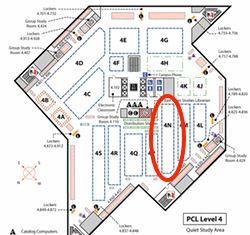
PCL-4N.gif Greg Mankiw's students' favorite book from his freshman seminar reading list was Milton Friedman's Capitalism and Freedom, so I'm adding that to my reading list for the Christmas break. Thanks, Greg Mankiw's students.

Note to self: HB 501 PCL 4N

Friday, December 4, 2009

Uwe Reinhardt on moral hazard and war

From Paying for Health Care (and War, by the Way) by Uwe Reinhardt:
"Moral hazard" is a term commonly applied to certain financial contracts, under which one party is obliged to pay another money if a specified event (e.g., illness or a fire or an accident) occurs. The term refers to situations in which the very existence of the contract alters the behavior of one party, so that it increases the probability of the event's occurrence or the size of the monetary payoff based on that event, or both.

In the context of health care, having an insurance plan will increase the likelihood that a person will actually use the health care system. It will also probably increase the resource-intensity of the treatments chosen by patients and physicians. Some economists even theorize that such coverage encourages unhealthy lifestyles and reckless behavior.

In the context of the wider financial sector, the now openly demonstrated willingness of our government—whether it be the Bush or the Obama administration—to make taxpayers bear the financial risk of serious mismanagement or risk within the private financial sector is likely to bring about the moral hazard of future mismanagement. Much has been written about that threat.

My point in the op-ed article was that the term "moral hazard" can also be applied to the contingency of war and its cost.

If the monetary and the blood cost of war are shifted mainly to citizens other than the elites who are empowered to declare war and decide how it is conducted, I argued, then that elite is more likely to embrace war and to spend on it.


The best definition I've heard for "moral hazaard" is "overconsumption due to artificially low prices". Most people in our society, myself included, pay an artificially low price for war, so we consume more than we would at equilibrium.

In my health econ class, we've looked a lot at moral hazard as it relates to insurance. It's interesting to note the more general applciation.

Thursday, December 3, 2009

Look! There's a $20 U.S. Federal Reserve Note on the ground!

From The Efficiency of Silver Coins by The Incidental Economist:
There is a famous joke about economists: Two economists are walking to the beanie propeller hat shop. One says, "Look! There's a $20 U.S. Federal Reserve Note on the ground!" (remember, he's an economist). The other says, "Can't be. If that were true, someone would have already picked it up." They walk on, leaving the $20 bill on the ground.

The joke is about the efficiency of markets. In an efficient market opportunities to systematically make profits above the market average don't exist. Any news that suggests a profit opportunity is taken advantage of nearly instantly and the extra profit is arbitraged away. The $20 is gone. It can't be there. Don't bother looking for it. This is the efficient market hypothesis (EMH) in a nutshell.

Considering the utility of that last .75 points

Going into my macro final I have a grade of 99.25/100. I have the choice of skipping the final and keeping that grade or taking the final and possibly raising my average to 100. (If I were to score 100 on the final I could drop my grade for Exam 2, which was 97. If I were to score under 97 on the final, that grade would be dropped and my average would be unchanged.)

Now I have to consider the costs and benefits of studying for and taking the final. I've been thinking I would take it, since that would make the study for it, which would help cement the things I've learned this semester into my brain. I'm still leaning that way. But I have a long to-do list at work and a looming deadline, so the opportunity cost of studying is high, and could be huge if I were to miss my deadline.

The potential grade difference isn't significant to me, so instead of using the final exam as a forcing function I think I'll work instead and commit to thoroughly reviewing the material after I'm over the hump at work, which will be around the end of January.

Still, it would be nice to have a perfect 100 average...

Sunday, November 29, 2009

The Expected Effects of the Public Option and Mandated Coverage on Health Insurance Premiums and Total Medical Expenditures

I wrote a short paper for my Health Econ class, and for kicks put it up on Google Docs. I'd love to get your feedback on The Expected Effects of the Public Option and Mandated Coverage on Health Insurance Premiums and Total Medical Expenditures.

Don't be intimidated by the title—it's almost as long as the paper itself. :-)

Update: FWIW I've also posted the paper in its entirety to my other blog here.

Sunday, November 22, 2009

Last regular-season game, er, exam tomorrow

The end of the semester (and quarter, and year) always gets busy and this time is no exception.

My third macro exam is tomorrow. Then I have a health econ paper due, then the health final exam. Plus another macro quiz and final somewhere in there, if I decide to take them.

I also have some super-exciting yet time-consuming stuff going on at work, and of course Thanksgiving, Christmas, and two kids' birthdays in the next few weeks.

Yee-ha!

Saturday, November 21, 2009

Skidelsky on the Treason of the Economists

Robert Skidelsky is nothing if not quotable. From his column last April, The Treason of the Economists:

Most of today’s crop of economists are not defunct, but continue to work in the ideological vicinity of Chicago. Their assumptions should be ruthlessly exposed, for they have come close to destroying our world.


I've added his most recent book Keynes: The Return of the Master to my Amazon wish list. :-)

Tuesday, November 17, 2009

Econometrics to be required

The economics department just sent out an email noting changes to the 2010-2012 catalog. Most notably, all economics majors will be required to take Econometrics (ECO 341K), which "introduces the student to standard regression procedures of parameter estimation and hypothesis testing in economics."

I won't be declaring the new catalog, but I'll take 341K anyway. I can't imagine studying economics without any exposure to econometrics.

Friday, November 13, 2009

Pre-commitment is for chumps

In my macro class we get to drop a quiz and a test (including the final), so assuming you've done well you can skip the last quiz and the final, and in fact the entire class after the Thanksgiving break.

Despite Dr. Sadler's pleas that no one actually do this it's tempting, especially for time-constrained students facing a full slate of final exams. However, I'm there not only for the grade but also for the knowledge, so I'll attend the last two weeks of class even if I don't get credit for it. I think.

The penultimate quiz is today, and it occurs to me that I could pre-commit myself to attending the post-Thanksgiving classes by skipping today's quiz. That way I'd have to take the last quiz on December 2 or risk a B in the class. Similarly I could pre-commit to studying hard for the final by skipping the next exam.

But I'm not going to skip either one. I'm fairly confident that I'll attend the classes and study for the final even if I'm not forced to, so the marginal benefit of pre-commitment is limited. Plus, skipping the quiz, the exam, or both would force me to put all of my eggs in fewer baskets, increasing the risk that I'd fail to get an A in the class. The risk simply outweighs the reward.

Also, pre-commitment is for chumps.

Tuesday, November 10, 2009

A dissenting view on specialization

“A human being should be able to change a diaper, plan an invasion, butcher a hog, conn a ship, design a building, write a sonnet, balance accounts, build a wall, set a bone, comfort the dying, take orders, give orders, cooperate, act alone, solve equations, analyze a new problem, pitch manure, program a computer, cook a tasty meal, fight efficiently, die gallantly. Specialization is for insects.”

—Heinlein, refuting Ricardo, in Time Enough for Love

I'm not THAT lazy

I like paying my bills online as much as the next guy, but this one I think I'll pay in person.

YIKES.png

Yikes!

Sunday, November 8, 2009

The Health Insurance Sausage Factory

There's a new blog, written pseudonymously, called The Health Insurance Sausage Factory. Looks substantive.

Tuesday, November 3, 2009

How to recover from a stall

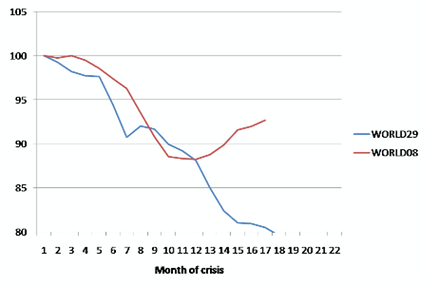
If I'm going to republish disheartening charts I should give equal time to the heartening ones, like this one from Paul Krugman comparing world industrial production during the Great Depression and the recent Great Recession:

two-crises.png

As any pilot knows, you recover from a stall by pushing forward on the stick, not pulling back, counterintuitive as that may be. Glad we've figured that out.

My, what pretty graphs you have

For drawing pretty graphs like these, OmniGraphSketcher is the bee's knees. Mac-only. $19.95 after educational discount. Highly recommended for econ students.

PS2-1.png

sp3-3.png

Monday, November 2, 2009

Saturday, October 31, 2009

Charlie Munger on hedging your bets

More from Charlie Munger:

One of the greatest economists of the world is a substantial shareholder in Berkshire Hathaway and has been for a long time. His textbook always taught that the stock market was perfectly efficient and that nobody could beat it. But his own money went into Berkshire and made him wealthy. So, like Pascal in his famous wager, he hedged his bet.


For those of you who like me don't remember Pascal's Wager, it's this:

If you erroneously believe in God, you lose nothing (assuming that death is the absolute end), whereas if you correctly believe in God, you gain everything (eternal bliss). But if you correctly disbelieve in God, you gain nothing (death ends all), whereas if you erroneously disbelieve in God, you lose everything (eternal damnation).


But of course Munger's famous economist won't lose nothing if his hedge doesn't pay off.

Charlie Munger on the great lessons of microeconomics

From Elementary, Worldly Wisdom by Warren Buffett's partner Charlie Munger:

The great lesson in microeconomics is to discriminate between when technology is going to help you and when it's going to kill you. And most people do not get this straight in their heads.


He goes on to explain:

For example, when we were in the textile business, which is a terrible commodity business, we were making low-end textiles—which are a real commodity product. And one day, the people came to Warren and said, "They've invented a new loom that we think will do twice as much work as our old ones."

And Warren said, "Gee, I hope this doesn't work because if it does, I'm going to close the mill." And he meant it.

What was he thinking? He was thinking, "It's a lousy business. We're earning substandard returns and keeping it open just to be nice to the elderly workers. But we're not going to put huge amounts of new capital into a lousy business."

And he knew that the huge productivity increases that would come from a better machine introduced into the production of a commodity product would all go to the benefit of the buyers of the textiles. Nothing was going to stick to our ribs as owners.

That's such an obvious concept—that there are all kinds of wonderful new inventions that give you nothing as owners except the opportunity to spend a lot more money in a business that's still going to be lousy. The money still won't come to you. All of the advantages from great improvements are going to flow through to the customers.

Conversely, if you own the only newspaper in Oshkosh and they were to invent more efficient ways of composing the whole newspaper, then when you got rid of the old technology and got new fancy computers and so forth, all of the savings would come right through to the bottom line.

In all cases, the people who sell the machinery—and, by and large, even the internal bureaucrats urging you to buy the equipment—show you projections with the amount you'll save at current prices with the new technology. However, they don't do the second step of the analysis which is to determine how much is going stay home and how much is just going to flow through to the customer. I've never seen a single projection incorporating that second step in my life. And I see them all the time. Rather, they always read: "This capital outlay will save you so much money that it will pay for itself in three years."

So you keep buying things that will pay for themselves in three years. And after 20 years of doing it, somehow you've earned a return of only about 4% per annum. That's the textile business.

And it isn't that the machines weren't better. It's just that the savings didn't go to you. The cost reductions came through all right. But the benefit of the cost reductions didn't go to the guy who bought the equipment. It's such a simple idea. It's so basic. And yet it's so often forgotten.


Munger sees another lesson from micro, one which should be familiar ato anyone reading this, uh, blog:

Then there's another model from microeconomics which I find very interesting. When technology moves as fast as it does in a civilization like ours, you get a phenomenon which I call competitive destruction. You know, you have the finest buggy whip factory and all of a sudden in comes this little horseless carriage. And before too many years go by, your buggy whip business is dead. You either get into a different business or you're dead—you're destroyed. It happens again and again and again.

And when these new businesses come in, there are huge advantages for the early birds. And when you're an early bird, there's a model that I call "surfing"—when a surfer gets up and catches the wave and just stays there, he can go a long, long time. But if he gets off the wave, he becomes mired in shallows....

But people get long runs when they're right on the edge of the wave—whether it's Microsoft or Intel or all kinds of people, including National Cash Register in the early days.

The cash register was one of the great contributions to civilization. It's a wonderful story. Patterson was a small retail merchant who didn't make any money. One day, somebody sold him a crude cash register which he put into his retail operation. And it instantly changed from losing money to earning a profit because it made it so much harder for the employees to steal....

But Patterson, having the kind of mind that he did, didn't think, "Oh, good for my retail business." He thought, "I'm going into the cash register business." And, of course, he created National Cash Register.

And he "surfed". He got the best distribution system, the biggest collection of patents and the best of everything. He was a fanatic about everything important as the technology developed. I have in my files an early National Cash Register Company report in which Patterson described his methods and objectives. And a well-educated orangutan could see that buying into partnership with Patterson in those early days, given his notions about the cash register business, was a total 100% cinch.

And, of course, that's exactly what an investor should be looking for. In a long life, you can expect to profit heavily from at least a few of those opportunities if you develop the wisdom and will to seize them. At any rate, "surfing" is a very powerful model.


Indeed.

"Economists" on Jeopardy! [sic]


HT: Tyler Cowan

Tuesday, October 27, 2009

Registered for Slesnick's micro theory class

ECO 420K (33545) MW 9:30-11:00, F 9:00-10:00

Monday, October 26, 2009

Picking a prof for ECO 420K

Since there will be no honors section of Micro Theory taught in the Spring semester, I have a choice of four professors for the non-honors version: Slesnick, Watson, Hayashi, and Dusansky.

The Course-Instructor Survey results and the ClassPoint reviews put Selsnick at the top of my list and Hayashi at the bottom. I'm going to check around, see what the kids think, and report back here. As if you care.

Update: Wrong choice.

More grades

100's on both my macro quiz and my health econ exam. Boom.

Thursday, October 22, 2009

Samuel Johnson meets Adam Smith

From The Worldly Philosophers, which I'm already enjoying a great deal:

Sir Walter Scott tells us that Johnson, on first seeing Smith, attacked him for some statement he had made. Smith vindicated the truth of his contention. "What did Johnson say?" was the universal inquiry. "Why, he said," said Smith, with the deepest impression of resentment, "he said, 'You lie!'" "And what did you reply?" "I said, 'You are a son of a bitch!'" On such terms, says Scott, did these two great moralists first meet and part and such was the classical dialogue between two great teachers of philosophy.


Too bad President Obama didn't take the opportunity to replay this exchange.

The waiting is the hardest part

Apologies to Tom Petty, but waiting to find out how I did on my health econ exam yesterday is killing me.

I wonder if I could pay the TA to grade my exam sooner. Seriously. People respond to incentives, and I don't see how there would be any academic dishonesty involved. Am I right?

I actually drafted an email to the TA offering her such a deal but thought better of it. I guess I'll have to wait until Wednesday to find out. Ugh.

Update: As Chris Selland pointed out, even the losers get lucky sometimes. :-)